|
 |
The Old St Beghian | |
| January 2026 | |||
George Robson (FN 57-64) recalls two faithful employees.
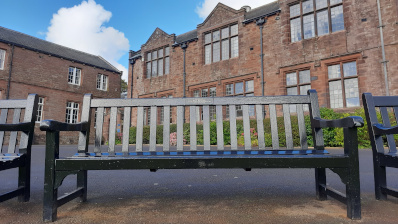
“One of the benches now on the terrace has affixed a plaque displaying:
PRESENTED BY
MISS S. APPLEYARD
MATRON, FOUNDATION HOUSE 1945-1979
ON HER RETIREMENT
It is hard to believe anyone ever exceeded thirty-four years employment at the school, but actually I am aware there was someone who did. Who it was will not be revealed until much later in this article.
Meanwhile let’s concentrate on the lady who did reach thirty-four years of service and whom many hundreds of Old St Beghians will recollect, especially those who were attached to Foundation House.
Widely known at the school as ‘The Nag’, Miss Sheila Appleyard trained in nursing and other medical matters during the war years before looking for a suitable post in a hospital or boarding establishment. She spotted an advertisement for matron at St Bees School in Cumbria, and when her college tutor discovered the application had been successful, warned Sheila not to stay in post longer than five years because a longer stay could well lead to some kind of unhealthy attachment to the place and stifle any hopes of advancement in the medical profession.
But on arriving at St Bees Sheila immediately felt happy and content with her life and moving on never crossed her mind.
I myself spent seven and a half years at the school, all attached to Foundation except for the first year when I was posted out to Eaglesfield. And living not too far from her home at Alnwick in Northumberland I met up with ‘The Nag’ (at school) and Sheila (back home) at all times of the year.
Sheila was the youngest of three sisters who had together inherited from their father a large and imposing early Victorian villa called Long Knowe on the outskirts of Alnwick. Her practice was to live during the school holidays at Alnwick, and at the school during term time. (Actually, she followed the practice of being at St Bees for one full week before and one week after each term to prepare for receiving/clearing up after the boys.)
The eldest of the three sisters was Ethel, who lectured in education at the nearby teachers’ training college based in Alnwick Castle. Neither Ethel nor Sheila married, but second sister Monica (Clark) did marry and went to Canada where she had a daughter, Sybil. It was therefore Ethel who lived year-round at Alnwick and maintained the family home.
It might be worth mentioning here that following a divorce, Monica after some training became matron of Meadow House under Peter Lever whilst her daughter Sybil spent a few terms in a junior position on Foundation before becoming a nurse at Whitehaven Hospital.
As regards accommodation at school, Sheila was given a room adjacent to the Foundation dining room and, on the floor above, a bedroom which was placed, appropriately and conveniently, adjacent to the sick room.
With her lounge being right next to the kitchens, her needs were few but nevertheless once per month she took a bus into Whitehaven to shop. But most of her leisure time was spent working at her rock garden which, some may remember, lay on the slope between the New (now called Science) Block’s car park and the Third’s rugby field. She was always looking for new plants and new ways to make the garden even more beautiful than it had already become.
Before evening prayers Sheila held surgeries, then, straight after lights out for the other boys, held court within the surgery for the house prefects in dressing gowns, drinking Horlicks and chatting about issues of the day.
Particularly important amongst her duties of course was caring for any boys consigned to the sick room, and to mind here come memories of the crisis weeks of the Asian Flu epidemic of 1957/1958 when at its peak just over half the boys were consigned to their dormitory beds. And here I have another recollection springing to mind. Before boys set off to the annual Scout or Cadet Force camps, each boy’s private parts had to be inspected. I remember us all lining up outside the surgery waiting for our turn with some trepidation and consternation.
When there was a special occasion for the school such as Speech Day, Sheila was expected to be ‘everywhere at once’ doing her best to ensure the day went off smoothly. It always did for she was ubiquitous!
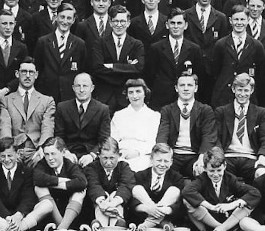
Sheila Appleyard (in white)
Foundation House 1946Sheila Appleyard (in white apron)
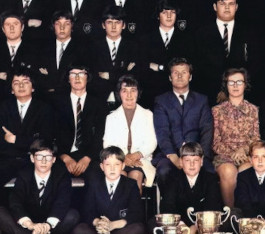
Foundation House 1956-57Sheila Appleyard (in white)
Foundation House 1972Back in Northumberland visits by me to the Appleyard home were quite frequent. And when I achieved a driving licence, I would take her for trips out for the day. For instance, I well remember our strolling together along the sea front at Seahouses then on our return journey stopping at a wayside chapel where, being noted as chapel organist, I played a few pieces to impress Sheila.
Of course, Sheila had to modify her ways of operation to work in concert successfully alongside the succession of Foundation housemasters. With Foundation being twice the size of both Grindal and School House (about 150 boys) there were two housemasters – one for Foundation North and one for Foundation South. I remember from my time we had John Shuff Hall, Peter Beaky Croft. Ron Slime Johnson.
Sheila had a great sense of humour and her loud resonant shrieks of laughter would often ring around the whole of the house. But early in 1962 we noticed these outbursts were much rarely heard. It turned out Sheila was diagnosed with some sort of cancer and in due course she became a patient at The Royal Victoria Infirmary in Newcastle. I, of course, felt driven to pay her some visits and do my best to cheer her up. I remember on one occasion when by her bedside she reached out and grasped firmly one of my hands which she held tightly until I left the ward. Her motivation for doing this was a mystery to me at the time and it still is.
Happily, Sheila’s operation was a success, and she resumed her work at the school.
Shortly after I finally left school in March 1964, long-serving master Anthony Spiv Dearle was moved from his room in Lonsdale Terrace in which he had resided since 1948 to take on the housemastership of Foundation North. As was to be expected, I suppose, Sheila occasionally let slip to me information that was perhaps better not given to pupils. On this matter and realising I was an ex-pupil she told me Anthony Dearle had become aware he was getting forgetful and easily confused (possible the onset of Alzheimers?) and each week gave Sheila a list of his duties/engagements for the week ahead and asked her to remind him of each.
The person referred to in the first paragraph of this article I will now name. It is May Dodds. As the consequence of having suffered polio when only a girl she had a pronounced limp, and so to the boys she was known as ‘Limpy’. May had been born in St Bees and became part of the Foundation House domestic team in 1940. During the war years her chief responsibility was ensuring wartime blackout regulations were adhered to. She would be answerable should the village’s warden charge the house with an infringement (though May assured me this never happened).
But in my time Limpy’s main responsibility was overseeing laundry matters. Once a week each boy’s clothing and bed linen had to be bagged and taken to a central location for Whitehaven’s laundry firm to collect. At the same time the previous week’s laundry could be collected from the same location. On top of this May also had certain responsibilities at mealtimes.
When 1979 arrived Sheila and May, both well past the statuary retirement age, together decided to call it a day and retire, these were major events as both had been liked and respected by the boys and looked on as institutions. May continued to live in her small cottage at the top of the village rented to her by Bill Fox. But it is nice to know the school did not forget her long service. Squads of pupils were regularly deployed to her cottage to carry out tasks to assist her - window cleaning, painting, general cleaning, gardening etc. Her final months were spent as a resident of a care home close to the village and where I once visited her and took a photograph which features at the foot of this article with one of her Priory gravestone.
I think it was in 1983 that I received a phone call from Bill Fox, who told me Sheila had died peacefully at her home. With the nearest crematorium being at Blyth, where I was by then living, he asked would I represent the school at the funeral and take with me a spectacular wreath? Of course I was very ready to do this.
At the funeral I met the last survivor of the three sisters, Ethel, and also Sheila’s niece Sybil. Both had travelled from Alnwick by taxi.
May Dodds
*In the Foundation dining room there is on one of the walls a plaque celebrating Limpy’s thirty-nine years’ service. This plaque was made and put in place by David Lyall and paid for by myself.
Is it too late to fix adjacent to it a similar one to Sheila?”
(Regarding long-serving employees at the school: May Dodds, whom George goes on to mention, served for 39 years, and the current groundsman, David Lamb, joined in 1982, and so has served a continuous 44 years to date! There may well have been others. Ed.)




Home
The St Beghian Society
St Bees School,
St Bees, Cumbria, CA27 0DS.
Tel: (01946) 828093 Email: osb@stbeesschool.co.uk
Web: www.st-beghian-society.co.uk
